
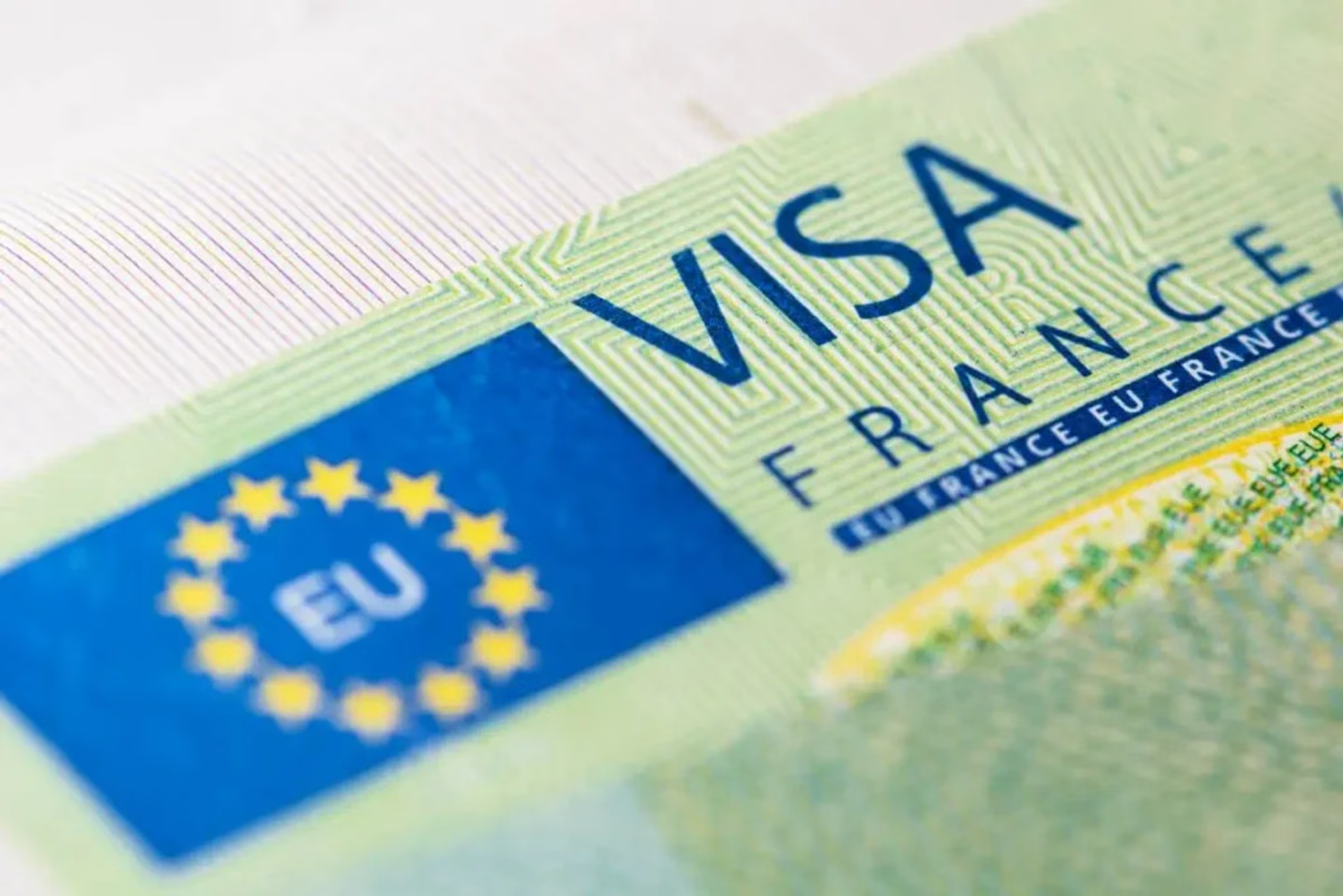
A recent case study of a GARANT.in client who obtained a French Type D visa in less than one month — from the 21st of January to the 17th of February.
In 2026, France has once again reinvigorated the residence permit programme for financially independent persons (FIP). Following a period during which consulates issued refusals and the programme effectively stagnated within the CIS market, consular practice has shifted; the procedure has been relaunched and has become one of the most expeditious in the European Union.
This case serves as confirmation that, with the correct preparation of documents and the assistance of specialists, the French residence permit process can be initiated within record timeframes and without investment.
Client Profile and Background
Alexander is an entrepreneur from Kazan and the owner of an online IT consulting business. His main income comes from outside the EU: dividends from his stake in the company and his investment portfolio.
For the past several years, he has lived between Russia, Dubai, and Europe, utilising a Schengen visa. However, the 90/180-day restrictions created discomfort — particularly given his plans to spend more time in the South of France.
He did not plan to purchase real estate in France, nor did he intend to invest in a business. His primary objectives were:
- to obtain a legal basis for long-term residence in France;
- to maintain tax residency outside the EU;
- to avoid taking language examinations;
- to avoid establishing a company in France;
- to complete the process as quickly and effortlessly as possible.
Selection of the Legalisation Programme
The solution was the French residence permit programme for financially independent persons (*Visa Visiteur* or *VLS-TS*).
This type of residency entails:
- the absence of the right to work in France;
- an official minimum net monthly income of at least 1,400–1,800 euros for one person, though in practice consulates almost invariably expect a higher income — approximately 2,500–3,000 euros per applicant;
- the absence of investment requirements;
- the absence of a mandatory language examination;
- the absence of an obligation to become a tax resident, provided the stay regime is observed.
It is important to understand that a national Type D visa is issued first, and only subsequently is the plastic residence permit card obtained within French territory.
Case Timeline
January 21st — Commencement of work with GARANT.in
The client promptly provided financial documents and bank statements.
First Week — Income Audit
Lawyers structured the sources of revenue: dividends and investment income were separated in the dossier to demonstrate stability and independence from active employment.
Second Week — Preparation of the Package
Particular attention was paid to: the translation of financial documents, the explanatory letter regarding the purpose of residence, and the correct positioning of income as passive.
February 17th — Receipt of passport with Type D visa
Less than a month from the start of the process, Alexander held the national French visa in his hands.
Document Package
The following were prepared for submission:
- application form for a national visa;
- valid international passport;
- long-term residential lease agreement in France;
- bank statements for 6–12 months;
- confirmation of monthly income;
- criminal record certificate;
- medical insurance for the duration of the stay in France;
- motivation letter.
Important! The key success factor is not merely the presence of a sum in the account, but the demonstration of the regularity of deposits.
Advantages of the French Residence Permit for FIP
| Advantage | Expert Explanation |
|---|---|
| Expedited processing | In France, with a correctly prepared financial dossier, the national Type D visa can be issued on average in 3–4 weeks, making the programme one of the most prompt in the EU. |
| Absence of investment | There is no requirement to purchase real estate, invest in a business, or participate in investment funds. It suffices to confirm a stable income and the presence of funds in a bank account. |
| No 183-day residence requirement | The programme does not oblige one to automatically become a tax resident provided the stay regime is observed, which is particularly important for international entrepreneurs. |
| No language examination | At the submission stage, there is no requirement to confirm knowledge of the French language, which reduces the preparatory period. |
| Transparent financial criteria | The main emphasis is placed on confirmed monthly income and financial stability, without complex investment structures. |
| Freedom of movement | The status allows for legal residence in France and free movement across the Schengen Agreement countries without the 90/180 limitation. |
| Prospect of renewal | The initial residence permit is issued for 1 year with the possibility of renewal and the formation of a stable migration history for future long-term status. |
Financial Requirements in 2026
The French programme for financially independent persons evaluates not merely figures, but the applicant's overall financial model. In practice, for assured approval, the applicant must demonstrate a stable, regular income sufficient for living in France without recourse to the social system, as well as the presence of savings confirming a financial safety cushion. Equally important is a transparent and meticulously documented origin of funds.
While the formally established minimum threshold may appear lower than market benchmarks, consular practice indicates that during case review, the key criterion becomes not formal compliance with minimum values, but the applicant's actual financial resilience, the regularity of deposits, and the logical structure of income.
Client Results
Alexander received:
- a legal basis to reside in France year-round;
- the right to move freely within the Schengen Area;
- the possibility of renewing the residence permit without investment;
- the prospect of permanent residency after 5 years.
"I expected the process to take significantly longer, at least 3–4 months. When my passport was returned with the visa after four weeks, it was unexpected and gratifying. I was aided by the competent preparation, the clear strategy of the GARANT.in experts, and their assistance at every stage."
Alexander
Who is Suited for the French FIP Residence Permit
The programme is oriented towards applicants who are financially independent and derive income outside the French labour market. In practice, this category includes:
- Entrepreneurs with an international business structure, receiving dividends or profits from companies outside the EU and not planning to open a French company.
- IT specialists, developers, product managers, and other digital professionals working remotely for foreign companies and receiving stable income from abroad.
- Marketers, consultants, designers, and analysts managing projects in international markets and not tied to a specific country of residence.
- Bloggers, influencers, authors of online courses, and experts monetising an audience via advertising contracts, affiliate programmes, or digital products (income must not be linked to the French advertising market or an audience in France, otherwise this may be interpreted as work without authorisation).
- Investors receiving income from dividends, coupons, real estate rental, or investment portfolios.
- Owners of real estate in France who wish to reside legally in their property without investment obligations.
- Families with confirmed passive or remote income interested in a European jurisdiction for residence, children's education, and free movement within the EU.
The key condition in all cases is singular: the applicant must not enter the French labour market, and their income must be stable, confirmed, and sufficient for independent living. It is for this reason that the FIP programme is becoming particularly relevant for the new category of mobile professionals who earn remotely and choose their country of residence based on quality of life rather than place of employment.
Conclusion
The French residence permit for financially independent persons is one of the most economical and rapid methods of legalisation in the EU. With a correct income structure and professional document preparation, obtaining a Type D visa is possible in less than a month.
The GARANT.in case confirms: the programme is working once again, and France remains one of the most accommodating EU countries for financially secure applicants.
Frequently Asked Questions
-
Is it permitted to work in France with a *Visiteur* residence permit?
No, this type of residence permit strictly prohibits the conduct of labour activity within French territory. You must derive income from sources outside the country (dividends, remote work, rent).
-
Is it mandatory to purchase real estate for the residence permit?
No, the purchase of real estate is not required. It suffices to provide a long-term residential lease agreement for a period of no less than 12 months.
-
Is it necessary to pay taxes in France with this residence permit?
The mere fact of obtaining a residence permit does not make you a tax resident. You become one if you reside in France for more than 183 days a year or if the centre of your vital interests is located here. If you observe a stay regime of less than six months, you may retain the tax residency of another country.
-
For what period is the *Visiteur* residence permit issued?
Initially, a Type D visa (equivalent to a residence permit) is issued for a period of 1 year. Subsequently, it may be renewed annually provided the conditions (presence of housing and income) are maintained.
-
Can one travel through Europe with this residence permit?
Yes, French resident status grants the right of visa-free movement through all countries of the Schengen Area under the regime of 90 days every 180 days.


