
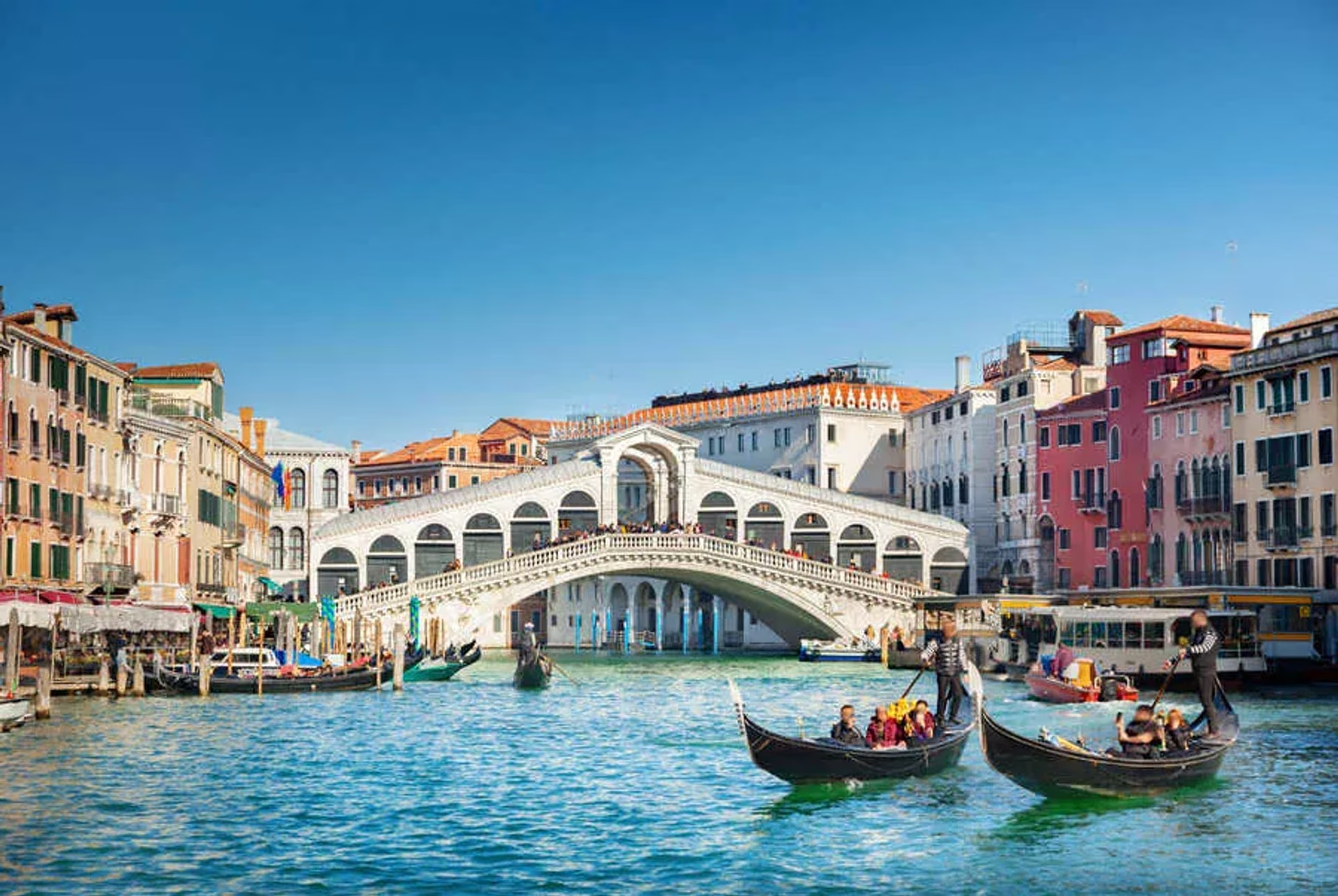
Obtaining an Italian residence permit is the first step on the way to citizenship. Italian residency is an opportunity to live in a country with a wonderful mild climate, developed economy, and rich history. Often relocants, having issued residence permits, do not understand what further actions should be taken and what documents should be drawn up for a comfortable life. The specialists of the migration agency GARANT.IN has analyzed in detail the advantages of a residence permit in this country and the documents that should be issued after receiving a residence card.
3 important documents for living in Italy
After obtaining the status of residence permit, the resident needs to execute several important documents that will greatly simplify life in the country and help in solving further bureaucratic tasks.
Tax number Codice fiscale
You can get a tax number in Italy (Codice Fiscale) in parallel with a visa or residence permit. The document is necessary for both temporary and long-term residence in the country. In Italy, the tax number is assigned to citizens upon birth, and to foreign residents upon request. It is possible to obtain a Codice Fiscale for an applicant of any age. If it is a minor applicant, then the application must be accompanied by additional documents: parents' passports and birth certificates.
For which a tax number is required in Italy:
- renting for more than 30 days and registering the contract;
- possibility to open an account with a local banking organization;
- payment of taxes, filing tax returns, and the possibility of getting a tax deduction;
- the opportunity to buy real estate in the country;
- the chance to get a job in an Italian company;
- VAT registration;
- enroll children in school/daycare;
- gain access to the local healthcare system.
In general, the Codice Fiscale is important for the immigration process and for completing a range of documentation for a successful relocation to Italy.
The tax number consists of alphanumeric characters, 16 in total. The number is based on the applicant's full name, date, and place of birth. Obtaining Codice Fiscale is extremely important for everyone and allows you to successfully solve several financial, professional, and legal issues.
To obtain a Codice Fiscale, one of the options is to:
- Submit a request to the Italian Consulate in the place of residence. The petition can be made together with the documents for a visa or already with a ready-made permit. The certificate is issued on an A4 sheet, and upon arrival in Italy, it must be replaced with a plastic card with a photo. The request for issuance is submitted to the Anagrafe tributary. The received document is valid for 10 years for adults and 5 years if the applicant is under 18.
- To issue a tax number already in Italy. To obtain a codice fiscale, the resident must submit a request to the migration department at the place of location. You can obtain the document in parallel with the issuance of a residence permit card.
Italian residence permit La Residenza
La Residenza in Italy is the place of registration of an individual. A foreign resident who has received a residence permit with a validity period of more than 3 months can register a place of registration and be listed as a resident of a particular municipality at the local address desk (l'Ufficio Anagrafe).
For what La Residenza is necessary in Italy:
- the issuance of an identity card (carta d'identita');
- to be able to use the services of social services and structures.
To obtain a La Residenza it is necessary to go to the address office of the chosen municipality and bring the following documents:
- valid resident's passport;
- valid residence permit;
- an issued tax number;
- a document confirming the lease or purchase of housing in Italy;
- a certificate that the housing meets certain criteria (certificate from the sanitary service).
After examining the data provided, the authorized staff will issue the applicant a certificate of acceptance of the registration request. At the same time, a check will be scheduled to verify the accuracy of the information about the dwelling indicated in the attached documents. At the appointed time, the inspection will be carried out by the municipal police.
In case of renewal of the residence permit status in Italy, the applicant must reapply for registration at the passport office within 60 days from the date of confirmation of the status, otherwise, his personal information will be canceled.
Health insurance for an Italian residence permit
The public insurance system (Servizio Sanitario Nazionale - SSN) in Italy is taxpayer-based, so all citizens are entitled to health services without having to pay compulsory contributions. Any foreign citizen can apply for a medical card (tessera sanitaria) and access the system. Under the public program, medical care is free of charge or for a small fee. Children, pensioners, and socially disadvantaged groups are exempt from additional payments. In addition, it is possible to obtain a voluntary medical policy and receive services that cannot be provided through the state program.
The presence of the policy is a prerequisite for applying for and obtaining various types of visas.
About 50% of Italian citizens, in addition to public insurance, take out a private medical policy, because it allows access to those products and specialized specialists, whose services without insurance will be extremely expensive.
If the holder of a residence permit officially works in Italy, he can register for free in the SSN. Students and pensioners also have this right. Other categories of residents can take out voluntary insurance, but at the same time regularly pay a fixed fee for services.
If a foreign resident has not registered with the SSN, he or she will need to take out a private medical policy. They are also allowed to combine them with government programs to expand the list of services.
How to register with the Italian National Health Service (SSN). In order to register, it is necessary to apply to the ASL (local health authorities) in the place where the applicant is registered. It is necessary to have the following documents:
- A valid residence permit or a document proving employment.
- Certificate of residence.
- A fresh tax return.
Of course, these are not all the documents that a resident may need to live in Italy. The list of certificates and papers will be formed depending on the needs, employment, the presence of family and children, and other factors.
Advantages of Italian residence permit
The new status and move to Italy allows the applicant to get access to various privileges:
Free movement in European countries and the Schengen zone. Residents of Italy can move freely around the EU and spend up to 90 days out of 180 in the Schengen zone.
Quality medical services. Foreign citizens with Italian residence permits can use the system of private and public services - Servizio Sanitario Nazionale. State insurance covers the lion's share of all services, emergency care is free for all. The quality of medicine is evidenced by the fact that the average life expectancy in Italy is steadily increasing, and today is about 84 years.
Prestigious European education. The residence permit status allows you to send your child to a state kindergarten or school, to enter a university on the same terms as those provided for local citizens.
Optimization of taxation. With a residence permit for FNL, residents must also pay taxes. In addition, they can formalize a Res Non-Dom status valid for 15 years and pay a fixed tax obligation of 100,000 €.
High quality of life. Rome is among the top 8 most comfortable European cities, according to Resonance Consultancy. The rating is based on the following factors: the safety of citizens, the presence of prestigious educational institutions, the number of sunny days per year, and the percentage of residents with higher education.
Rich cultural heritage. Italy boasts the presence of 58 sites protected by UNESCO - this is about 5% of the total number of such structures.
The opportunity to extend the migration path. With an Italian residence permit after 5 years you can apply for permanent residence, and after another 5 years - to apply for citizenship. Provided that the resident will not violate the laws of the country and meet the primary requirements based on which he received a long-term status.
If you need assistance in obtaining a visa, residence permit, obtaining other important certificates, please contact the migration agency GARANT.IN. Our specialists work face-to-face and remotely, helping in any difficult situations.
