
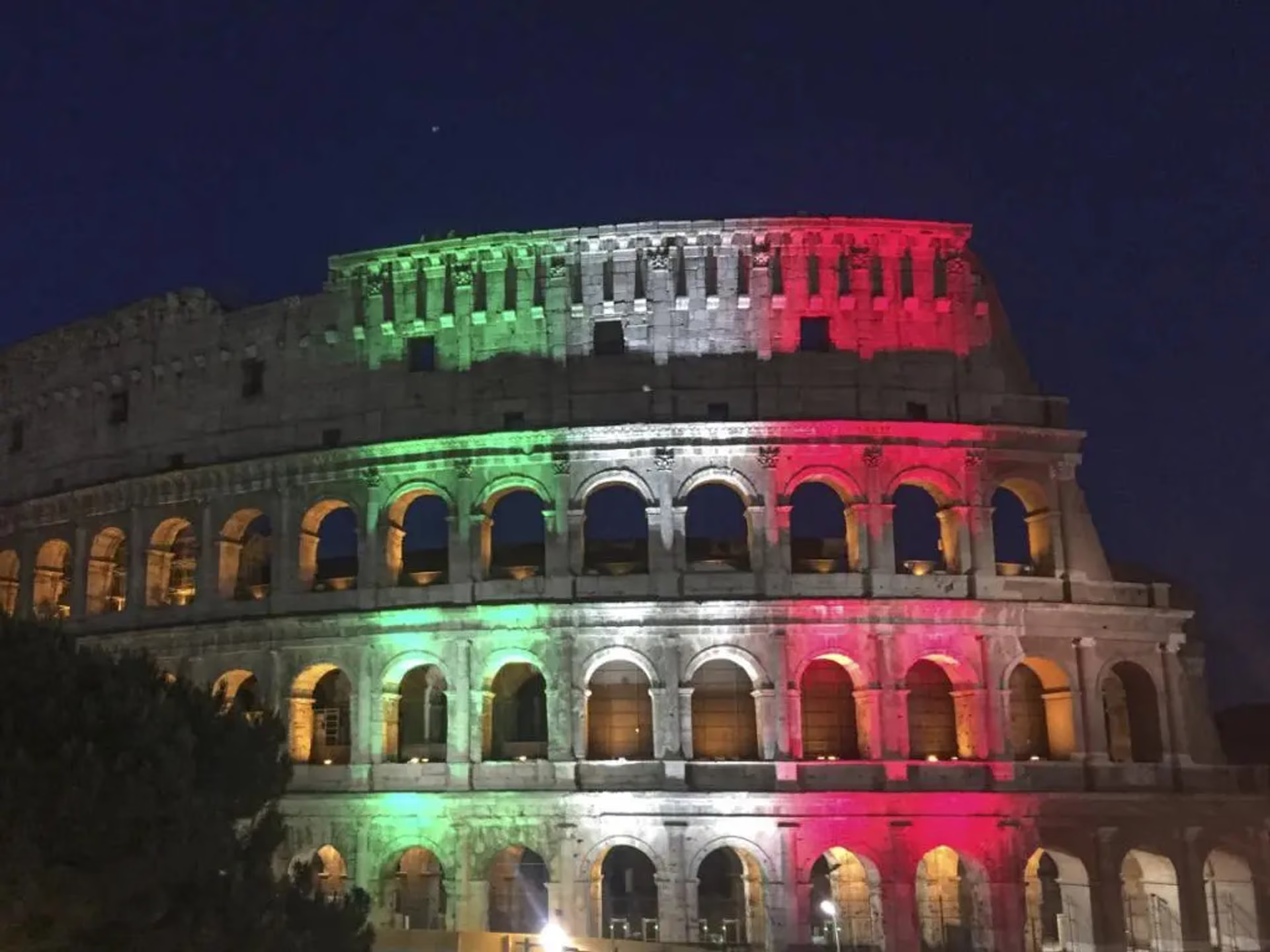
Many residents of Ukraine and Russia are attracted by the prospect of emigrating abroad, especially to Europe, which offers its citizens a high standard of living. Thousands of people strive to obtain residency permits in Malta or Italy and acquire citizenship in Austria. Sunny Italy is also a leader in labor immigration and relocation for permanent residence in Europe.
The advantages of living in Italy include:
- Warm, mild climate
- Affordable food
- Free medical care
- Guaranteed pensions
- Ability to travel and work in any EU country
- Favorable loan conditions
- High wages
- Excellent business prospects
- Good education
However, obtaining Italian citizenship requires quite some time. The first step for relocation is obtaining a residence permit, which requires a national visa type "D".
Types of Residence Permits
It's important to note that such residence permits vary in the rights they grant to immigrants. There are visas that:
- Allow for employment
- Permit work and study
- Prohibit work and study
A residence permit with the right to work suits those who want to work for an Italian company or start their own business in Italy. For the former, an employer's invitation is needed; for the latter, sufficient funds, a business plan, and a license for operation are required. A residence permit with the right to study and work is issued to those who come to the country to get an education. This document limits work hours to 20 hours per week. A residence permit without the right to work is granted to property owners in Italy who have sufficient funds to live in the country. Another way to get this status is to request family reunification, based on official proof of kinship with a resident of the Italian Republic. Each method of obtaining a residence permit has its specifics, which should be understood before moving.
Business Immigration
If you decide to move to open your own business, you can expect a positive outcome, but be prepared for significant costs. To confirm entrepreneurial status, you must have at least €10,000 in an Italian bank account. A stable income from your business (over €20,000) and regular tax payments are necessary to extend the temporary residence permit issued for entrepreneurial purposes.
Otherwise, after immigrating to Italy, your business will be subject to the same requirements as those of Italian citizens' businesses. There are no requirements for the number of jobs created or the need to hire administrative staff, etc. If your business is successful and you have lived in the country for a long enough period, you can apply for permanent residence and then citizenship.
Real Estate Purchase
Buying a property does not guarantee obtaining a residence permit in Italy. However, if certain conditions are met, a property owner has a high chance of getting the necessary documents to live in the country. Besides property ownership documents in Italy, you need to provide bank statements showing €50,000-€70,000 in your account. The income level for living in the country should be at least €17,800 or more.
Citizenship by Descent
Italy offers citizenship to those who can demonstrate Italian ancestry. It's hard to predict the number of people interested in such an appealing offer, but various sources estimate about 83 million ethnic Italians worldwide, with the largest communities outside Europe in North and South America, especially in Argentina, Brazil, and the USA.
Conditions for Obtaining Citizenship by Descent
Applicants must have an ancestor who:
- Was born in Italy, regardless of how many generations ago
- Was alive and not yet a citizen of another country as of March 17, 1861
- Did not undergo naturalization in another country before July 1, 1912
The program includes other nuances, and if descendants can prove these, they may apply for citizenship by descent.
Required Documents
- Old passports
- Marriage certificates
- Italian birth certificates
- Genetic evidence
- Church records and other documents
This list is not exhaustive for documents containing important information about the applicant's ancestry and family ties.
Step-by-Step Immigration Process
The first step for immigration to Italy is to obtain the appropriate visa. At this stage, it’s important to get a resident visa, not a tourist one. The next step for obtaining a residence permit involves applying. The completed form can be sent by mail or filled out at the police department. The residence permit application must be accompanied by:
- Copies of all pages and the original passport
- Four 3x4 photos
- Duty stamp
- Criminal record certificate
- Purchase or rental agreement
- Documentation proving the right to obtain status (with a notarized translation)
The temporary residence permit is valid for 9 months to two years and must be renewed. This permit is a step towards the second stage of immigration: obtaining permanent residency. To get a permanent residence permit, you must live in Italy for five years. This status allows indefinite residence in any EU country. You can obtain the document by submitting:
- Copies of tax returns and income statements
- Four color photos (3x4)
- Passport and copies of its pages
- A certificate of no legal issues
- Certificates of residence and family composition
- Proof of housing
- Postal receipt of application fee
The permanent residence card must be renewed every five years, with only a new photo required. The permanent residence provides rights similar to those of Italian residents, except for voting rights. Ten years after immigration to the Italian Republic, you can apply for citizenship. In some cases, the time to obtain citizenship is reduced. According to current law, those who can become citizens of the country include:
- Spouses of Italian residents after two years of marriage and continuous residence in the country
- Spouses of Italian citizens after three years of marriage while living abroad
- Children born in Italy after three years
- Adopted children of Italian citizens after five years
- Those who have been in government service for five years
Italian laws allow dual citizenship, which is convenient for those who do not want to give up their home country but want to enjoy the benefits of living in Europe.
Cost of Living in Italy
Italy is a popular destination for our clients looking to buy property and move permanently. It’s no surprise, as it’s a country with a high quality of life, a developed economy, and an ancient culture. Some choose picturesque small towns, while others are drawn to the buzz of megacities.
Living Standards in Italy
In 2023, the living wage in Italy is €855. The average income level varies significantly by region. For example, in Venice, it's €2,500, while in Verona, it’s no more than €1,300.
The highest salaries are received by doctors, finance workers, insurance employees, translators, engineers, builders, and fashion industry workers.
To determine the cost of living in Italy, it’s necessary to base it on the average annual income, which is about €30,000, assuming both spouses work. The average salary in the country is €1,200. The average monthly budget for a couple is €1,500. For large cities, add €400-€500. The most budget-friendly cities are in the south. If a couple rents an apartment, add €500 or more.
These are average figures, as each person's needs, income, and expenses differ.
Utilities
Italians pay for gas, heating, water, and electricity. Gas is used not only for cooking but also for heating. Utility payments start at €1,000. If you have a TV or radio, add €110 tax per unit. Internet costs about €30 per month, and mobile phone minutes cost €0.15-€0.17.
Food
The average restaurant bill is €50-€60 for two, including a main course, salad, appetizer, and a bottle of wine. Buying groceries in a store costs €150-€180 per month per person. Interestingly, food prices in Italy are slightly lower than in other EU countries, but alcohol and tobacco products are quite expensive.
Household chemicals, cleaning, and laundry supplies cost about €40-€50 per month for a family.
Real Estate in Italy
In previous reviews, our experts have mentioned that the Italian real estate market is experiencing stagnation. For the first time in many years, the market has not only stopped growing but has declined by 1%-1.5% in some regions. For investors, this is a significant advantage as they can buy liquid property at favorable prices. The most expensive properties are in the north, while prices drop closer to the south. This rule applies to both buying and renting.
Wardrobe
Expenses on clothing and shoes in Italy are quite reasonable. Italians spend an average of €130-€150 per month on clothing for a family of three. Italy produces many high-quality local brands at affordable prices.
Healthcare
Italian healthcare is considered free. In public clinics, you can get almost any service for free and of excellent quality. The government ensures that treatment in hospitals and access to medications are available to most people. Some services and medications require separate payments, either a percentage of the cost or full coverage. Diagnostic procedures, laboratory tests, and dental services are paid.
Pensions in Italy
Like in many European countries, pensions in Italy are based on contributions. The final amount depends on the number of contributions made during a person's working life. Women must contribute for 41 years and 7 months, and men for 42 years and 7 months. If a working citizen wants to retire before age 60, pension payments will be reduced by 1%. In Italy, the average retirement age is 66, regardless of the field of work.
Education in Italy
State education in Italy is free for all citizens. Like in many European countries, the education system is divided into several stages: preschool, primary, secondary, and higher education. Planning to move to Italy with children requires careful study of this issue, as the enrollment process in Italian kindergartens and schools may vary depending on the region and the institution level.
Preschool Education
Kindergartens in Italy are divided into private and public institutions. Public kindergartens are free, with a fee of €70-€150 per month for food. Private kindergartens cost €350-€700. Children attend kindergartens from 8:00 AM to 4:00 PM. The enrollment age is 3 to 6 years.
Primary Education
Primary school lasts for five years. Children are enrolled from ages 6 to 11. The first two years are preparatory, focusing on mastering basic skills and behavior. Each class has two teachers. Primary school education is mandatory and free for Italian citizens.
Secondary Education
Secondary education is divided into three stages. The first stage lasts three years (middle school) and provides general knowledge. The second stage also lasts three years and includes two divisions: lyceum (focused on preparing for university) and vocational schools (focused on specific skills and trades). Secondary education is mandatory until age 16.
Higher Education
Italy boasts some of the world's oldest and most prestigious universities. Most higher education institutions are public, with low tuition fees. The government provides scholarships and financial aid to students based on merit and financial need. Higher education is accessible to both citizens and international students.
Conclusion
Living in Italy offers many benefits, from a high quality of life and excellent healthcare to affordable education and diverse real estate options. The process of relocating and obtaining citizenship can be complex, requiring careful planning and meeting various requirements. However, for those who can navigate the process, Italy provides a welcoming and enriching environment.
