
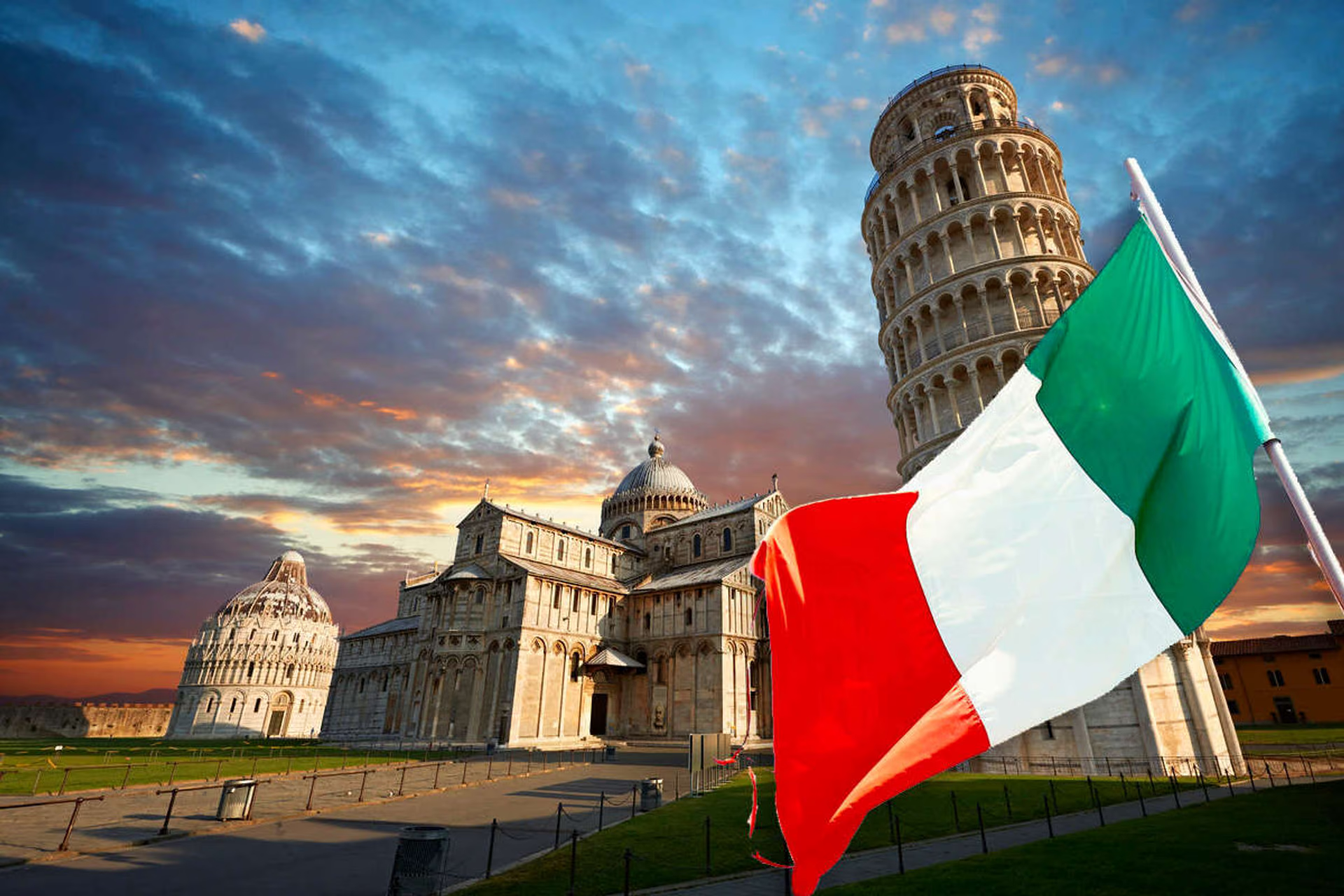
Every year thousands of people are attracted to the beautiful and alluring Italy, who wish to move here for permanent residence. Specialists of the migration agency GARANT.IN regularly receives requests from clients to apply for residence permits, permanent residence permits, and citizenship through various programs. Often we are asked: "What advantages of living in Italy can you name personally from yourself? We have collected the impressions of our clients, analyzed the reviews of those who have been living in Italy for more than a year, and added observations from our own experience.
If you are still in doubt and can not decide to move, we have prepared a list of the main advantages of living in Italy. Perhaps someone will consider these as additional arguments for moving.
Quality of life
Italy is a country famous for its unhurried and relaxed rhythm. There is no clarity here that a Russian resident is accustomed to, and in general, there is a rather high level of bureaucracy, but the environment itself is relaxing and pleasant. Italy is a calibrated balance between historical charm and modern conveniences. A mix of natural riches such as a mild climate, an abundance of sunny days a year, beautiful nature, and landscapes are combined with an abundance of historical monuments, delicious cuisine, and people's attitudes. Italians are considered to be one of the most friendly and welcoming nations. The people of Italy are in no hurry to get anywhere and enjoy the moment, showing participation and friendliness even to strangers.
Even the smallest cities boast well-developed infrastructure, access to medical services, good roads, and good public transportation.
An atmosphere of friendliness and participation
Even if you are new to Italy and do not speak Italian well, you will not be abandoned in trouble but will listen attentively and try to help. No irritation or arrogant attitude towards a person. When asking for directions, you can be sure that the Italian will not only explain everything thoroughly but will also guide you a little to show you the exact directions.
Italians are open-minded and unhurried. They know how to enjoy life and the moment: a cup of coffee or a glass of wine, leisurely contemplating the world around them. No one here is in a hurry or a rush. Italians probably do not know stress, irritation, and hurry. People who move to Italy for permanent residence, adopt the habit of living in the moment and live happily.
Delicious and quality food
In Italy, there is a real cult of food, so the quality of food is given special attention. Health and good mood directly depend on it.
Italy is a country with an abundance of sunny days, there are a lot of seasonal fruits and vegetables at an affordable price. You can talk about the cuisine of Italy endlessly, Italian dishes are known all over the world, and Italian chefs are considered unsurpassed experts in their craft. We can rightfully say that each dish of Italian cuisine is a real work of art, a balanced symbiosis of taste, aroma, and ingredients.
Proximity to the sea
The sea in Italy can be found almost anywhere in the country, it is everywhere! It takes 1-3 hours to get to the sea from anywhere in the country. Near the capital, the favorite place of rest is Ostia Beach. In the warm season, it is full of vacationers who want to refresh themselves in the waters of the Mediterranean Sea. If you go to the south - towards the cities of Sperlonga and Gaeta, there you will find cleaner beaches, fewer people, and beautiful landscapes for photos.
Italian authorities have tried to make the sea as accessible as possible for everyone, so there are a lot of public beaches with free entrance. There are paid beaches where you can rent an umbrella and a deck chair, but you can also just relax in a public area on your blanket. Vacationing by the sea is the most popular pastime among Italians.
Climate
The climate in Italy is quite mild and varies slightly in different parts of the country. Southern regions are famous for hotter days, bathing season can last from May to October. It is not uncommon for the air to warm up to +45 ℃ in summer, but the air is quite humid.
In the northern part of the country, the Alps have a significant influence on the climate. At the foot of the mountains, the temperature rarely drops below -1℃. But in the cities located at altitude, winter frosts up to -20℃ are not uncommon.
In the central part of the country, the climate is considered the most comfortable and mild. The climate in Tuscany is particularly mild, with winter temperatures never dropping below +8℃ and summer temperatures rarely rising above a comfortable +27℃. It is in this region that you can see the largest number of villas, estates, and luxury buildings.
Convenient location
If we talk about the capital of Italy - Rome, from it you can easily and quickly get to any European capital. Lowcosters allow you to travel for little money, it is quite realistic to travel all over Europe from Italy. Italy has 29 airports, and a well-developed railroad and bus network. 1-2 hours of flight from Italy and you are on the spot, if we talk about Europe.
Education
Even non-residents of Italy can send their children to school. According to Italian legislation, every person has the right to education. A child can be enrolled in a kindergarten or school without any problems. In state universities education is free, but it is important to pass entrance exams.
Education in Italy is at a high level, some Italian universities date back to the 12th century and are recognized as some of the oldest educational institutions in Europe. Getting education in Italy is an opportunity to attend lectures of accredited European professors, oriented in teaching on modern methods, to participate in innovative seminars, to practice in modern, equipped laboratories and the opportunity to intern in other European countries, oriented on student exchange programs.
Medical services
Italy has a well-developed medical system. The information is regularly confirmed by various global ratings and classifications. According to Bloomberg, Italy deservedly took the second place in the ranking defining the healthiest nations in the world! The data for the analysis was provided by organizations such as the UN and WHO.
According to the World Bank, the average life expectancy in Italy is 82.1 years, which is only a couple of years lower than in the country of long-livers - Japan. Italy has well developed not only private but also public medicine. Not only citizens but also residents with residence permit status can use access to health care. For this purpose it is necessary to obtain a state health insurance policy - Tessera Sanitaria. The cost of the policy for a year can not exceed 2789 €. The total amount is calculated individually for each applicant, it all depends on the amount of annual income.
Another option is to take out a commercial insurance policy, which costs from €1,000 per person per year. Many Italians take out this type of insurance because it allows them to get some services faster than the public policy Tessera Sanitaria.
Emergency medical care is free of charge and it is available to everyone, even if a person does not have health insurance.
Doing Business
Italy has the third largest economy in the European Union and the eighth largest in the world, according to the consulting firm PwC. It is profitable to start or expand your own business here. Transferring a business to Italy is quite realistic and not very difficult. One of the most popular options for immigration is to open a company in Italy. This is also one of the ways to get a residence permit in the country.
In favor of doing business in Italy is the fact that the country, according to Forbes ratings in the category "The best countries in the world for business" is in the top 30. The Italian government comprehensively supports foreign investors, and taxation in the state, compared to other countries of the European Union, is quite loyal.
Italy's economy is characterized by stability and low volatility. It has resiliently survived the energy crisis and inflationary periods. Before the pandemic period, the country's GDP grew by an average of 1% annually. The economy sagged by 9% in 2020, but leveled off that year, not only returning to pre-pandemic levels but even growing slightly.
Italy is a leading country in international trade, exports, and tourism. ⅔ of the country's GDP is provided by the service sector: trade, café and restaurant activities, business services, transportation, and shipping. These industries employ over 50% of Italian companies and about 68% of salaried employees.
Italy has one of the most stable real estate markets. Despite the rise in the price of construction work by 15% over the last 8 years, the cost of primary housing has increased by only 7%. This is the lowest than the EU average.
Taxation
Income tax in the country is calculated on a progressive scale, the final rate will directly depend on the total annual income. Depending on the final amount, the rate can range from 23% to 41%. Tax residents who spend more than 183 days a year in the country must pay tax on worldwide income. Non-residents remit only tax on income earned within Italy.
Residents who have obtained status through the Investor Visa for Italy program can apply for preferential tax status and remit income tax at a flat rate of 100,000 € per year for 15 years.
Tax on real estate, if it is the place of official residence of the owner, is calculated at a rate of 0.4-0.7% of the cadastral value of the object. The rate level will be affected by the status of the territory on which the house is located.
Peculiarities of obtaining migration status in Italy
To enter Italy, you must initially obtain a targeted national D visa. What does it mean? The D visa will be opened for the specific type of residence permit for which the applicant is applying. The permit is issued for one year and can be applied for at the Italian consulate in the place of residence. To apply for a residence permit, one must visit Italy and submit the documents to the Migration Service within 8 days.
In most cases, before applying for a visa it is necessary to obtain a Nulla Osta - a permit for a long-term stay in Italy.
Nulla Osta is required in the following cases:
- employment for hire;
- registering and running a business;
- family reunification;
- marriage to a citizen of the country;
- investment program.
All documents: Nulla Osta, D visa and residence permit are important parts of the same program and must have the same purpose of moving to the country. You cannot apply for a Nulla Osta to register a marriage and then apply for a D visa to register and run a business.
If you do not want to deal with such legal intricacies on your own, to save time and effort, seek help from qualified specialists of the migration agency GARANT.IN. We will help you choose the best purpose for your trip, analyze several options, help you collect, prepare, translate, and epistolize documents, get a visa and permit, and settle issues with moving and adaptation to a new place. Start a new life with our support!
