
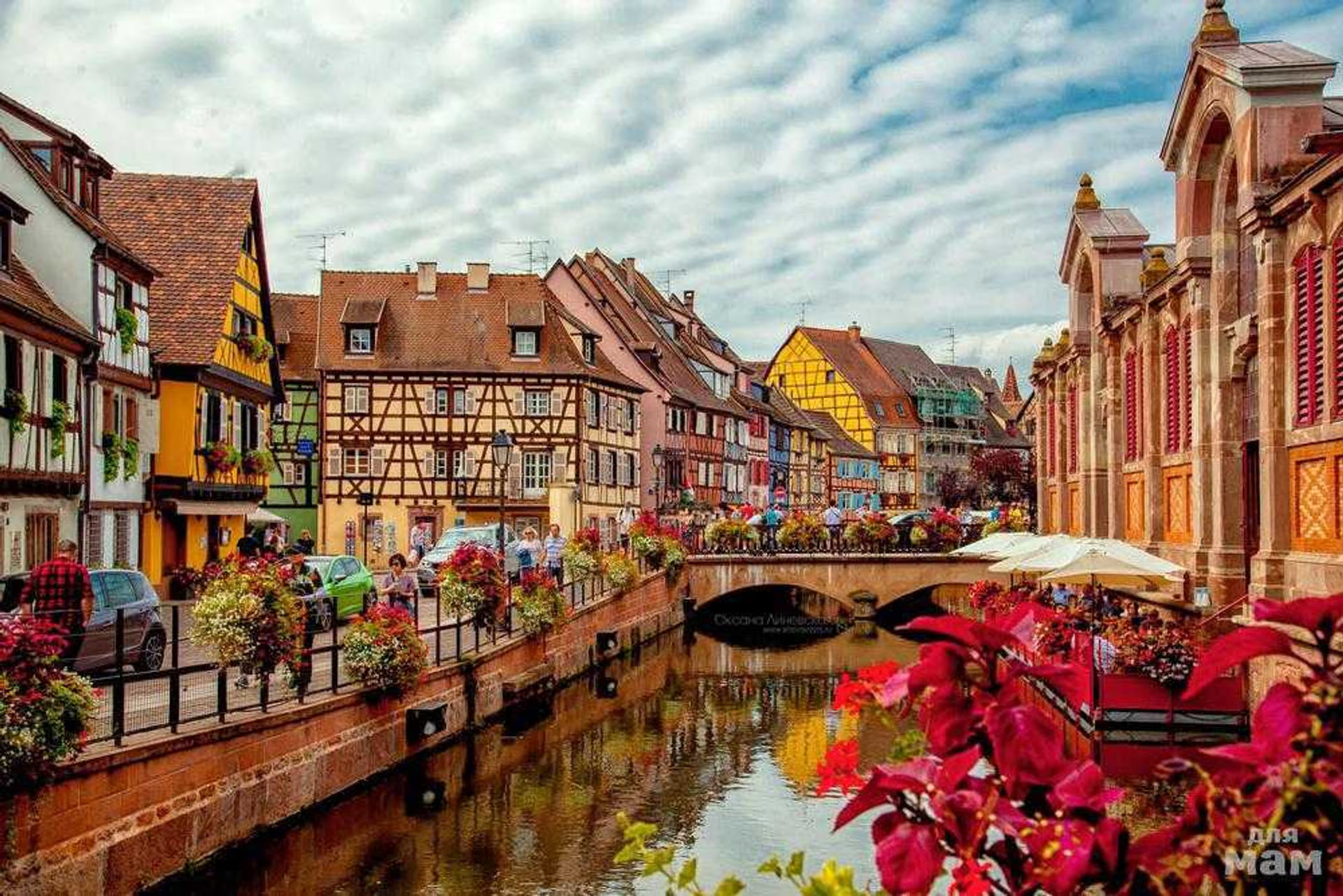
The real estate market in France is surprised with its diversity. Here you can find objects for every taste and purse. In 2021 there was a sharp increase in demand for luxury housing, as well as middle-class housing. Foreign investors consider French real estate as a reliable asset with the prospect of rising prices for square meters, so they are willing to pay a lot of money for it.
However, it is worth realizing that it is quite difficult to buy housing in France without the help of specialists. This country has its own rules for the sale of real estate, which should be known to potential investors.
Conditions and procedure for concluding a contract of sale and purchase of real estate
French legislation does not limit the rights of foreign citizens to purchase real estate in the country. An important condition is the provision of information about the sources of origin of the invested capital. This clause exists to secure the domestic market from attempts of "money laundering".
The purchase and sale of real estate in France with the participation of foreign investors is carried out through a notary. His competence, as a representative of public interests and guarantor of the legality of the owner's right to sell the property, also includes the registration of real estate.
The signing of a preliminary agreement between the parties is an obligatory stage in the registration. It has a standard form specifying the price, terms, and conditions of the transaction. This document also provides for further prepayment in the amount of 5-10% of the value of the real estate that has become the subject of the contract. The funds are transferred to the account of the notary. The buyer has the right to change his mind without losing the deposit up to 10 days after signing the preliminary agreement. In case of termination of the transaction after this period at the initiative of the buyer, the security deposit remains with the seller. If the finalization did not take place through the fault of the seller, the deposit is returned to the buyer. Without consequences and financial losses is the termination of the preliminary contract for objective reasons that do not depend on the will of the parties.
Additional costs when buying real estate in France
Expenses for the purchase of real estate in France, as in other countries, are not limited to the cost of the object. Legislation provides for several mandatory payments, the list of which will depend on the type of real estate.
An undoubted plus for non-residents is the fact that when formalizing a contract of sale in this country, all documentary litigation is handled by a notary. He gives the buyer a single bill, known as a "notary fee", which includes the cost of notary services, government fees, and taxes.
The costs of buying properties on the secondary market amount to 7-10% of the total cost. They consist of taxes payable on the purchase of an existing property, transfer fees, notary fees, and other fees (stamp duty, land registration, etc.).
When buying a new property, the associated costs in the form of fees and taxes amount to 2% of the value of the subject of the contract. This is because omitted some of the procedures inherent in the registration of "secondary", such as re-registration of the property from the old owner to the new. Also in France, there is a VAT of 20%, which is most often included in the cost of new construction.
The established amount of remuneration of the notary - 1% of the amount of the notary fee, the rest goes to pay taxes and other payments.
Peculiarities of investments in objects in the process of construction
In the case of acquiring an object on the primary market in the construction process, the investor gets the opportunity to make payments in several installments. Of course, in this case, there is a risk, but there are also several guarantees and insurances. For example, the guarantee on the structure of the object is 10 years, and on internal works - 2 years.
Features of investments under the Leaseback scheme
It should be noted at once that Leaseback programs are not suitable for foreign citizens who want to find a new home or a place to rest in France. The reason is - the limitation of the rights of the owner to freely dispose of such real estate.
The scheme provides an opportunity to invest only in new construction, which is subject to compulsory insurance, and its completion is guaranteed by the state. The most popular objects under the French Leaseback program are rightly considered to be hotel complexes and residences.
For those who expect to receive a return on investment, French Leaseback can be an ideal scheme for investing capital:
- state guarantee of commissioning of the object;
- yields of up to 4% per annum;
- guarantee of payments from the management company, regardless of whether the property was leased or not;
- tax benefits and the possibility of VAT reimbursement in the course of fulfillment of the terms of the contract;
- the right to personal use of the property for up to 4 weeks per year (under a standard contract) or more (under a special contract);
- all financial risks and expenses for the maintenance of the real estate are assumed by the management company.
To summarize!
The diverse real estate market in France has no restrictions for foreign citizens. The mechanism of the transaction and payment of taxes on the purchase is maximally simplified. State support for tourism and a focus on attracting capital from abroad contribute to the growing popularity of French real estate among investors wishing to preserve and increase their savings.
For more information, you can always contact the lawyers of GARANT.in. We will answer all your questions and help you achieve your goals.
