
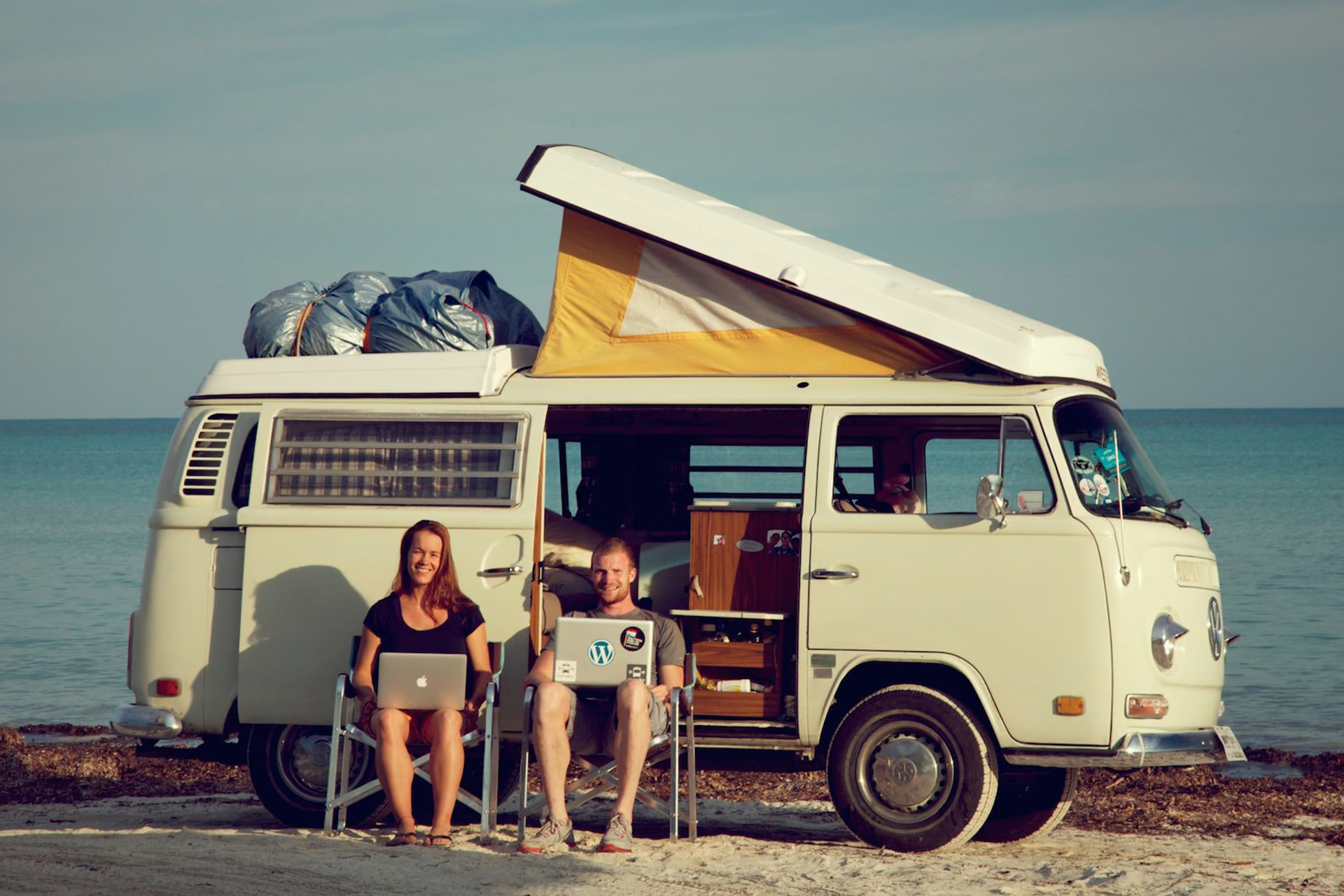
In the age of information technology, the online space plays a huge role in the life of modern man. Several professions involve working remotely on the Internet from anywhere in the world. Thus, a new category of professionals has emerged - digital nomads.
Digital nomads are remote employees of IT companies or freelancers who travel the world without taking time off work. Many countries already have special visas for them (Digital Nomad Visa), which allow them to stay in the country for a year or more with full freedom of movement. In some countries, such people are even granted tax benefits. The main condition of the preferential program for digital nomads is to confirm income from foreign sources at least at a minimum level.
The Digital Nomad Visa allows the holder to stay in another country longer than on a regular tourist visa and work legally. Visa requirements vary from country to country. It is important that the applicant has a job that can be done from anywhere in the world, covers minimum financial needs, and has a valid health insurance policy.
How did it all begin?
American programmer Stephen Roberts is considered the progenitor of digital nomads. He equipped his bicycle with solar batteries to charge his laptop and set off on the road without stopping to work. Roberts rode 27,000 kilometers. Arpanet, the prototype of the Internet, was used for communication. The name itself was introduced by the authors of the book "Digital Nomad" - David Manners and Tsugio Makimoto. This phenomenon became widespread about 10-15 years ago.
What industries have the most digital nomads? They exist in all industries that can perform tasks remotely. These include professions such as:
- copywriter;
- copywriter, journalist;
- designer;
- frontend and backend developer;
- marketer, advertiser;
- translator;
- SEO-optimizer;
- photographer;
- teacher;
- blogger;
- virtual assistant.
The above list is by no means a complete list of professions that allow you to lead such a lifestyle.
At present, the number of digital nomads continues to increase systematically. According to the statistics of the Nomad List community, the majority of digital nomads are US citizens (23.2 million people and 48% of the total number). About 7% are subjects of the UK, which ranks an honorable second place in this list, and 4% of the total number are Canadians and Germans.
Advantages and disadvantages of living as a digital nomad
Digital nomads themselves and their lifestyles look incredibly attractive in the eyes of society. The freedom of movement of a person who doesn't have to sit in an office every weekday from 9 to 18, and the opportunity to travel the world and expand their circle of acquaintances are the most common reasons why people make this choice. Others find it even more appealing to wait out the hot summers in Denmark or Finland, and the cold, freezing winters in Spain or Greece. To understand 100% whether you'll be comfortable, you need to scrupulously calculate the pros and cons before making a decision.
Benefits of living as a digital nomad:
- a more fulfilling life due to the constant change of scenery - the opportunity to travel can create a kaleidoscope of new experiences;
- the opportunity to gain much more knowledge, skills, familiarity, and experience, and to learn to settle in quickly;
- the opportunity to learn foreign languages and cultures, broaden your horizons, and increase your erudition, which will certainly be useful in your chosen field of activity;
- complete freedom of movement, the opportunity to choose any country with comfortable oneself domestic and climatic conditions, and in some cases - corresponding to the doctor's recommendations (for example, sea air). Some people "roam" seasonally, moving to warmer countries in winter and cooler countries in summer. The main thing is to comply with the laws of the host countries.
Disadvantages of digital nomads' life
For all the obvious advantages, there is a downside to this coin. The most weighty disadvantages of the life of a digital nomad can be attributed to the following:
- lack of stability. Constant moves, with which a person loses his or her place of residence and social ties, can seriously tire a person. Not everyone adapts to this lifestyle;
- Infrastructure problems in some countries - for example, due to poor quality of communications or utilities, which can cause serious discomfort and affect performance;
- the need to carefully study the legislation of each new country to avoid problems with the tax office, and sometimes not only with the tax office;
- difficulty in finding new social connections;
- the need to be always on the alert, to study in advance the specifics of local life and manners, as foreigners are at a higher risk of becoming a victim of a fraudster or thief;
- decreased productivity due to too frequent or unplanned moves;
- increased travel and accommodation costs, as it is not always possible to find out about the most favorable offers in a new country.
With all these disadvantages, digital nomadism is a very interesting experience that can help you broaden your horizons and see the world not only from the perspective of a tourist but also as a person who lives permanently in a particular region or country.
How do you become a digital nomad?
If you have weighed all the pros and cons, and you are sure that you are ready for the above difficulties for the sake of new experiences, take care of the following:
- A high-paying job where you have already completed your probationary period and have established yourself as a permanent employee;
- Work experience - especially important if you are a freelancer;
- fluency in foreign languages - at least English;
- communication skills - you will have to communicate with a lot of people to get the information you need;
- normal tolerance of road, flights, and time zone changes.
You also need to remember about timely registration and renewal of visa, registration, and health insurance, as well as taxation in the country you have chosen to move to. If you do not have time and desire to deal with such subtleties, the lawyers of the licensed agency GARANT.IN will always come to your aid.
Specifics of taxation of digital nomads
Such specialists reside in the country based on an appropriate visa, which gives them the right to stay in the country for 1 year or more. During this period, the digital nomad receives the status of a tax resident, and this entails the problem of double taxation (the country of employment or registration of the company and the country of residence).
To avoid this, many countries offer tax incentives for digital nomads. It is better to familiarize yourself with the information about them before moving to be fully prepared. It is important to remember that tax breaks only apply to active income (salaries and bonuses), while passive income (rental property, royalties, dividends) is taxed in general.
Today, many countries offer visas for digital nomads. We have selected the most popular offers for comparison:
- Portugal is one of the most popular countries for digital nomads. Temporary residents are attracted by the mild climate, excellent infrastructure, and reasonable cost of renting accommodation. The digital nomad visa is active for 2 years, then it can be extended. And after 5 years apply for permanent residence and further passport of Portugal on naturalization.
- Brazil and the island of Mauritius are the most affordable conditions for obtaining a Digital Nomad Visa. The applicant needs to indicate income from 1500/month. Visa application is processed in 2-3 days.
- Dubai - to get the desired permit, one should show an income of $5,000/month. This is one of the highest requirements for the applicant among all similar programs.
If your goal is to obtain a Digital Nomad Visa, contact the specialists of the migration agency GARANT.IN. We will help you to choose a country and a program that meets your requirements. Some countries have a limit on issuing such visas. For example, Cyprus issues no more than 500 Digital Nomad visas per year. With us, you will get the desired permit in a short period without overpayments and unnecessary efforts.
