
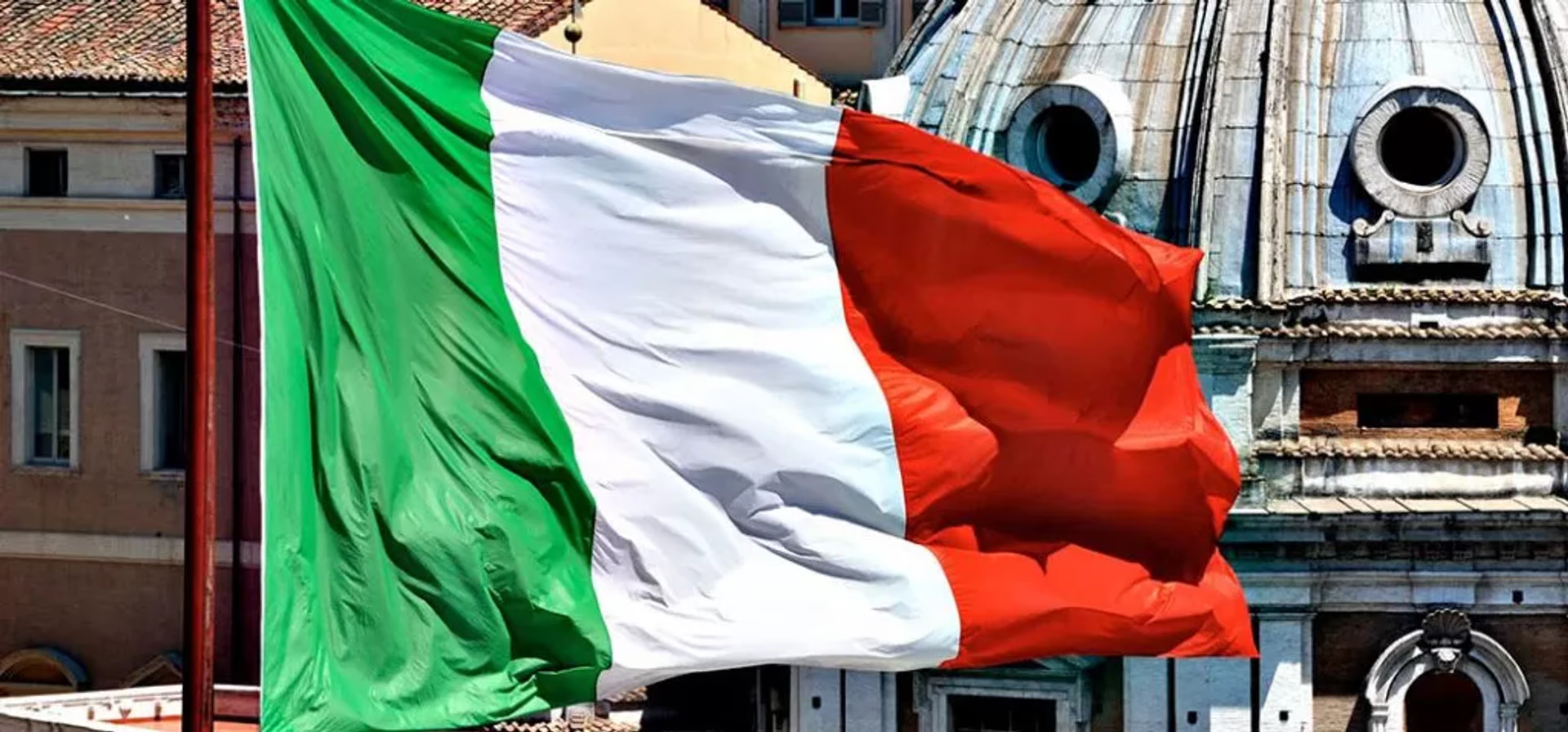
Italy is a stunning country with a mild climate, rich history, and incredible cuisine. Real estate in Italy is generally cheaper than in many other European countries, except in major cities and resort towns such as Rome, Milan, Venice, and Portofino. Both residents and foreign nationals are allowed to purchase the property.
Before purchasing, it is crucial to ensure that the selected property is free from any encumbrances. When selecting commercial real estate, it’s important to verify the list of permitted activities. It is also advisable to inquire in advance about utility costs, taxes, and other essential factors.
Current Real Estate Market Trends in Italy
Since the relaxation of COVID-19 restrictions, foreign residents have been buying up seaside villas and homes en masse from March to April 2022, significantly revitalizing the Italian real estate market. The recovery in tourist numbers and housing demand has sparked increased interest among investors and raised prices in the premium segment.
The first quarter of 2023 brought a less optimistic outlook—a decline in the real estate market has been observed during this period. By January, analysts recorded a 0.3% decrease in the average price of secondary housing.
According to the National Institute of Statistics (Istat), the first decline was noted in the third quarter of 2022. At that time, the number of notarial purchase agreements was 221,000, a 2.6% decrease compared to the second quarter of 2022. Of all transactions, about 95% involved residential properties, and only 5% were commercial.
Only 0.3% accounted for special-purpose properties. The statistics indicate that the decline in the residential real estate sector was recorded in almost all regions of Italy. The most significant decreases were observed in the South (-7.1%), the Islands (-3.7%), the Central region (-3.0%), and the Northeast (-2.6%). Demand for commercial properties significantly declined on the Islands (-5.8%) and in the Southern region (-5.3%). However, some areas showed positive trends: the Northwest (+2.1%), the Central region (+1.8%), and the Northeast (+1.5%).
Market Overview and Prospects for 2023
The top locations for transactions over the last decade remain unchanged—Milan, Rome, and Bologna. Although the start of the year saw stagnation and even a slight market downturn, by the end of 2023, an increase in the price per square meter of 1.5%-4.5% is expected not only in these cities but also in Turin, Verona, and Genoa. However, Palermo and Naples are expected to see further price declines, with a decrease of 1%-1.5% by year-end. The most popular type of property in Italy is three-room apartments, accounting for slightly more than a third of all transactions. This trend is likely to continue in 2023.
Why Italian Real Estate is Always Popular Among Foreign Buyers:
- Lifestyle Investment: Owning property in a country with a mild climate, a developed economy, and a stable political environment.
- Solid Investment: Despite the slight decline at the beginning of the year, the Italian real estate market shows slow but steady growth.
- Rental Income: The potential for stable passive income from renting out property.
Long-term rentals of residential and commercial properties are one of the main ways to earn in Italy, with average returns of 4-6% annually in euros. For resort properties or luxury properties in major cities, returns can increase to 8-10% annually. Earnings from short-term rentals and property resale can be high but come with numerous risks. Engaging in these activities is advisable only if you have a thorough understanding of the market or reliable legal support.
Affordable Real Estate Options
Analysts are yet to predict how long the stagnation in the Italian real estate market will last. Some regions, such as Lake Como, Lugano, Maggiore, Tremezzo, and Argegno, remain in stable demand at any time! The slight market downturn has created a pool of affordable options in the Calabria region and on the island of Sicily, where properties can now be bought for around €70,000 to €200,000.
Italy also has a unique category of real estate—“houses for 1 euro.” These are old, abandoned properties that require at least €150,000 in investment. Demolishing the structure and building a new one is prohibited—you can only restore or renovate. For those who appreciate historic buildings located in picturesque corners of Italy, this is a great opportunity to obtain housing for free and restore it according to your taste. Moreover, it allows you to gradually invest money over three years instead of paying the entire amount upfront.
The goal of this program is to preserve historically valuable real estate and support the local economy. To apply, registration with the local municipality is required.
Most Liquid Real Estate in Italy Over the Last 3 Months
Over the last three months, there has been unprecedented demand and, consequently, a price increase for office spaces, warehouses, and shops. In 2023, commercial premises generated around 12%, compared to 11.5% last year. Offices this year offer a return of 9.5%, compared to 9.2% in the previous period.
Residential Real Estate
The residential real estate market is currently stagnant, with the same performance as the same period last year—7.8%. The highest returns are seen in Ragusa, where real estate yields 10.7%, followed by Biella with 10%. Above-average returns are recorded in Syracuse at 9.1% and Trapani at 9.0%. Novara and Perugia are at around 8.2%. The average return is recorded in Milan—5.5%, Rome—5.4%, and Naples—5.7%. The lowest returns are in Salerno—4.6% and Venice—4.7%.
Shops
Surprisingly, shops have taken the lead, surpassing other types of real estate. A shop owner in Milan can expect a return of 15.5%, in Venice and Genoa—15%. The lowest returns are recorded in Massa—9.8% and L’Aquila—8.6%.
Office Spaces
The most liquid offices are in Verona—10.2% and Monza—10.1%. In Ancona, an office yields about 9.8%, and in Rome—8.8%. In Naples—7.6%, in Milan—6.4%. Bergamo, Mantua, and Pescara show around 6.4%.
Parking Spaces
Another way to earn in Italy is to rent out a garage or parking space. The highest return is recorded in Bari—7.6%, followed by Rome and Milan—6.8% in each city. Naples shows no more than 4.8%, as the prices for garages and cars are highest here.
The Procedure for Purchasing Real Estate in Italy
Documents Required for the Transaction:
- Purchase agreement;
- Proof of ownership;
- Building permit;
- Cadastral documents;
- Energy certificate.
The purchase can be made by an individual or a legal entity.
Advantages of Purchasing Real Estate in Italy for Foreign Residents
When purchasing Italian real estate, the owner automatically becomes a holder of a “resident visa,” allowing them to stay in the country for 180 days a year and freely enter Schengen zone countries.
If your goal is to obtain Italian residency, purchasing real estate can be an important factor influencing the commission's decision, provided all other legal requirements are met. In any case, such a purchase is a profitable long-term investment with minimal financial risk. The country has strict restrictions on new construction, so there is no oversupply of properties. If you plan to rent out the property, you can expect stable returns of 4.8% – 5.2% annually, depending on the type of property (commercial or residential) and location (major city, suburb, or resort area).
Payment Procedure
Payment for purchased real estate is only allowed through non-cash means. A check verified and confirmed by an Italian banking institution is used for payment. Another option is to transfer funds from a foreign bank to the seller’s account. In some cases, transferring funds to the notary's escrow account is permitted.
Purchasing Real Estate in Italy
It is impossible to purchase real estate without an identification number (Codice fiscale). Price negotiations are often conducted in writing. The owner sends a letter indicating the price, contract terms, and penalties for violating the contract terms. The buyer can state their conditions.
After all requirements are approved, the buyer transfers a non-refundable advance payment in case of deal refusal. If payment will be made in equal installments over a long period, a preliminary contract is signed. If the buyer can immediately transfer the full amount, the preliminary contract is not needed. Otherwise, a contract is drawn up specifying: information about the parties, the full price, payment procedures and deadlines, advance payment, and information about the transaction property. The document is notarized, and who checks the ownership and other documents? A fee of 1-3.5% of the property’s price is charged for notary services.
Taxes on Purchase
Depending on the type of property and the buyer's status, a registration tax is paid. For regular properties, it ranges from 2-10%, for luxury properties, it can reach up to 22%. If the purchase is made on the secondary market, the tax is calculated based on the cadastral value rather than the market value. If a foreign resident does not have residency status, the tax will be higher, but they may qualify for tax benefits in such cases:
- The property is not premium-class;
- Similar benefits have not been used previously;
- Registration in the purchased property occurred within 1.5 years after the transaction.
Final Contract Signing
The final contract (contratto notarile di compravendita) is drawn up in languages understandable to the parties. A translator must be present during the signing. The notary certifies the contract and issues a certificate. By this time, the buyer must have fully paid the seller. Often, the buyer transfers funds intended for taxes and fees to the notary, who then distributes them to the relevant organizations. The notary also sends the documents to the cadastral office, tax office, and registration chamber.
If you are interested in purchasing real estate in Italy, need consultation, or help in choosing, processing, and acquiring a property, we are here to assist you. GARANT IN, an international company specializing in investment immigration, residency, and citizenship in Italy for over 10 years, will handle any issues, saving you time and resources.
