
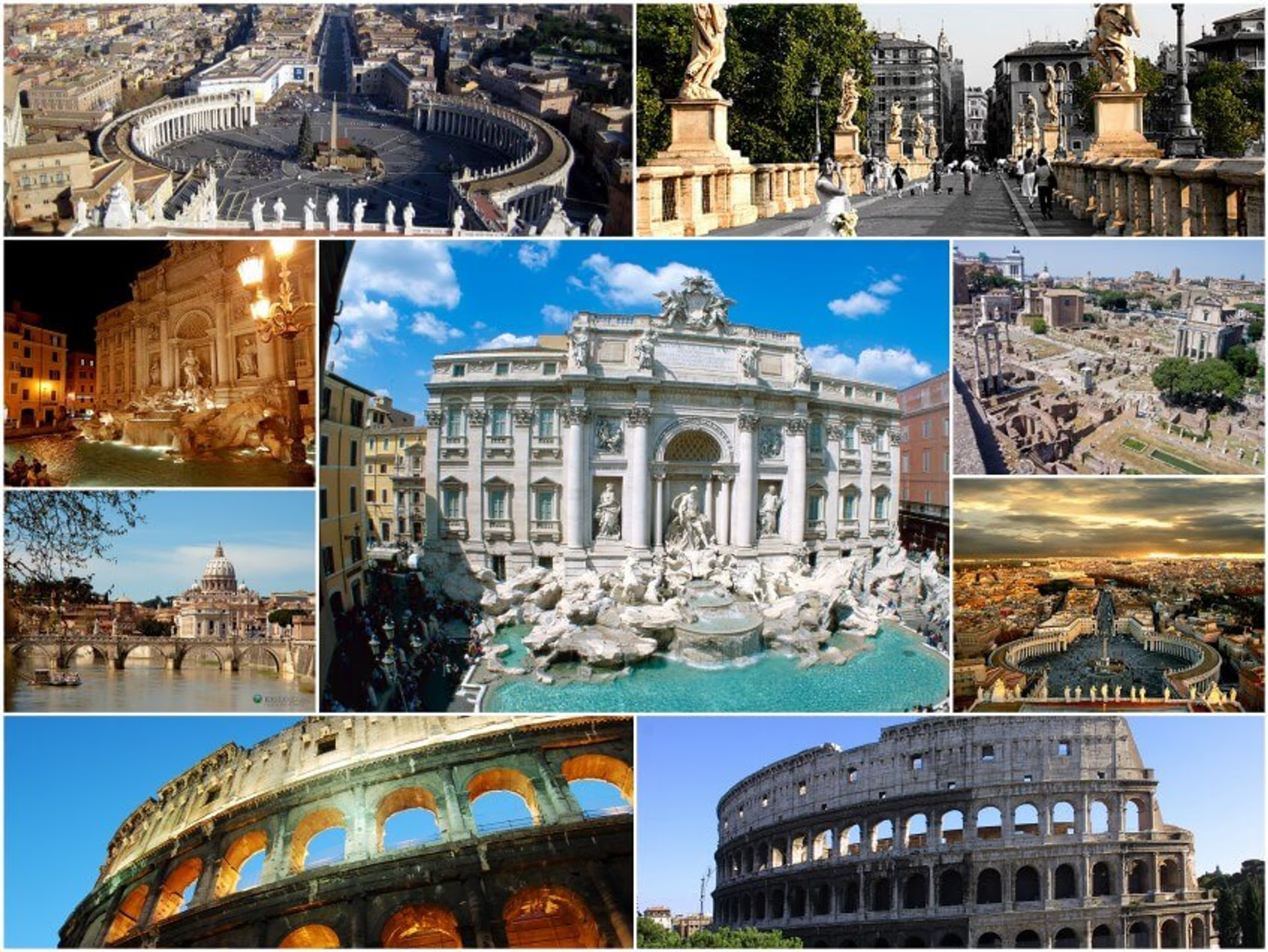
The beauty of Italy can be written and talked about endlessly. There are 58 UNESCO World Heritage Sites on the territory of the country. Italy attracts tourists with its beautiful nature, rich history, delicious cuisine, and wonderful weather. Even in winter time in the southern part of the country is quite a mild and warm climate. Almost every corner of the Italian Republic amazes with an abundance of beautiful places, and such cities as Rome, Bologna, Venice, Milan, and Florence - just a treasure trove of luxurious architecture, historical monuments, museums, cathedrals, galleries, and unrivaled landscapes. Today we want to tell you about the 10 most significant places in this beautiful country, which you should visit in Italy.
Colosseum
The No. 1 historical landmark in any guidebook. A majestic monument of architecture from the times of ancient Rome. The construction of the amphitheater was carried out for 8 years from 72 to 80 AD. More than 100,000 slaves were involved in the construction of the monumental structure. For a long time, the Colosseum was the main place for entertaining the citizens, where gladiator fights, battles with large predatory animals, and sea battles took place. More than 50,000 spectators could gather here at the same time! A fire in 217 caused considerable damage to the structure, but it was later restored.
For almost 2000 years of its existence, the Colosseum has survived several major earthquakes. One of them in 1349 caused a massive collapse of part of the structure. The Colosseum was then looked upon as a source of building material for other buildings. To our day the amphitheater did not reach its original form, but even today it amazes with its size and majesty. This tall elliptical building, almost 200 meters long, is deservedly considered one of the surviving wonders of the world.
Valley of the Temples
The island of Sicily is a beautiful corner of Italy, where you can see a beautiful valley full of ancient temples, which were discovered as a result of numerous excavations. Many of the buildings were created even before our era. For example, the majestic temple of Zeus was erected around the 5th century BC. Many temples were built in honor of ancient gods - Vulcan, Zeus, Juno, and Hercules. Temples are located at a considerable distance from each other, but between them, you can see other interesting structures - aqueducts, mosaic floors from different eras, the tomb of Theron, and the Basilica of Villa Atena. The Archaeological Museum located here has preserved a lot of treasures from the past - statuettes, sarcophagi, and pottery.
Pompeii
The city, completely buried under ashes after the eruption of Vesuvius, was built over 2000 years ago. Thanks to numerous excavations that began 17 centuries after the tragedy, tourists have been able to see the magnificent cultural heritage of this place - houses, temples, marble statues, frescoes, mosaics, and unique facades. The city is recognized as an open-air museum and is included in the UNESCO list. Today there are no excavation works, only restoration activities are carried out. It is estimated that about 25% of the city has yet to be excavated.
Leaning Tower of Pisa
A unique "falling" structure in the city of Pisa attracts tourists from all over the world. The peculiarity of the tower is a deviation of 3.97 degrees (almost 4 meters vertically). The slope appeared as a result of the architect's error in the construction of drawings. Also, the "fall" was affected by miscalculations in laying the foundation and a discrepancy in the soils. Only in the coming century, specialists were able to stop the gradual fall of the structure. The construction of the tower took 177 years, and the structure is a bell tower and part of the Cathedral of Santa Maria Assunta. As with any bell tower, the Leaning Tower of Pisa houses a belfry with a huge massive bell. There are short half-hour guided tours here; it is forbidden to walk around the grounds on your own.
Milan Cathedral
The construction of the largest cathedral in Europe began in 1386 and continued until the beginning of the XIX century. Until the end of the twentieth century, the exterior and interior of the building were being renovated. The intricately designed structure, located in the historical center of Milan, is built in the style of flaming Gothic. An abundance of spires, turrets, and columns are connected by a huge number of soaring supports. The cathedral can hold up to 35,000 people at a time - an impressive figure. The marble cladding is one of the main features of the cathedral, setting it apart from the buildings standing next to it. Inside the structure there are over 3,400 sculptures and the walls are decorated with works by great Italian artists. The cathedral has an observation deck that offers breathtaking views of the entire city.
Sistine Chapel
Another majestic creation that cannot be overlooked. Built between 1473 and 1481, it was designed by architect, sculptor, and artist Michelangelo Buonarroti. It is a large-scale structure 20 meters high, fully decorated with frescoes and works by Michelangelo, Botticelli, Perugino, Ghirlandaio, and Cosimo Rosselli. Inside you can see many beautiful sculptures, balconies, and graceful columns.
By the way, Michelangelo remodeled his work several times, due to his lack of experience in decorating buildings of this scale. The Sistine Chapel houses a men's choir (including a boys' choir) known as the Papal Chapel. The frescoes in the Chapel have undergone several restorations. The most extensive one lasted 24 years and was completed in 1994.
Vatican City
Traveling in Italy, it is impossible not to look into the "state within a state". Tourists from all corners of the world come here to appreciate the scale of the residence of the Pope. The city-state amazes with an abundance of attractions at every turn. In addition to the mentioned Sistine Chapel, you should visit the Vatican Gardens and Basilica Sancti Petri, which reaches a height of 130 meters! It is also home to the famous Vatican Library, numerous sculptures, frescoes, and paintings created by internationally recognized geniuses from different eras. To get into the Vatican territory, you need to buy a ticket in advance and comply with the dress code and rules of behavior, about which it is better to learn in advance from local guides.
The Trevi Fountain
The Trevi Fountain was named for its unusual location - it feels like it connects three streets. The fountain was designed back in the 17th century, but the final construction was only completed in the following century. It is the largest body of water in the city with a height of 26 meters and a width of almost 20 meters. According to the author's idea, the Baroque fountain is a single architectural composition with the Palazzo Poli palace behind it. Each sculpture in the reservoir is unique and you can look at them for hours. According to the belief, to return to Rome, you must throw a coin into the fountain. Every year, special employees collect about 1,000,000 euros from the water. In 2019, the fountain was supplemented with night LED lighting.
Uffizi Gallery
The beautiful museum in Florence is recognized as one of the best art museums in the world. In one place you can admire outstanding works of art by Botticelli, Rubens, Leonardo Da Vinci, Titian, Michelangelo, and other great masters of Europe. The arrangement of the Uffizi is fully in line with the modern museum concept - all works of art should be accessible to everyone. In 2013, the Uffizi set a kind of record - over 1.87 million people visited it during the year, which made the gallery the most visited museum in Italy.
Pantheon
An architectural marvel, the Roman Pantheon has been called "the sphinx on the Champ de Mars". It received this name because of the series of mysteries, riddles, and rumors that fill its history. Throughout its existence, the Pantheon has been a pagan shrine, a courtroom, a tomb, a church of the Virgin Mary, and a place of worship for emperors. The structure was built between 118 and 125 AD, as evidenced by the brick markings on the building. At the base of the building are many arches that rest on 8 pillars. The arches correspond to eight compartments at floor level, in which graceful statues are located. The entire structure is crowned by a monumental dome.
Travel to all of the above places without problems will help Schengen visa. Unfortunately, it allows you to spend only 90 days out of 180 in European countries. To travel freely in all European countries without time limitations, it is necessary to get a residence permit. Italian residence permits can be obtained on different grounds - employment, education, medical treatment, and company registration, for financially independent persons.
Licensed agency GARANT.IN will help you not only with the choice of grounds and obtaining a visa but also the execution of documents, residence permit card, driver's license, search for schools, rent, and purchase of housing. Any task that will be assigned to our specialists will be realized taking into account the client's request in the shortest possible time.
